A Norwegian supertrawler operated by Aker QRILL, Saga Sea, caught and killed yet another humpback whale this year in their pursuit of the tiny Antarctic crustacean, krill . According to preliminary reports from the October annual meeting of the Commission for the Conservation of Antarctic Marine Living Resources (CCAMLR), the whale died sometime between April 16 – 22 but was not found until gear was hauled in on April 22, 2026, in the northern Antarctic peninsula area referred to as Area 48.1. This brings the number of reported humpback whale deaths in the Antarctic krill fishery to nine since 2021 (one whale was alive during release but in such poor condition, the incident has since been re-classified as a mortality- see paragraph 5.26 in WG-FSA-IMAF-2024), seven of which seem to have been attributed to Norwegian fishing operations. For further details, see the most recent CCAMLR krill fishery report and additional referenced reports in pages 18-20.
Aker QRILL Company is 60% owned by American Industrial Partners, a U.S. private equity firm, and 40% by Aker ASA, a Norwegian company chaired by billionaire Kjell Inge Røkke.
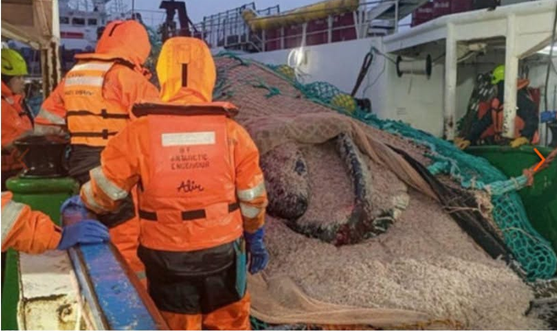
Photo taken by an observer from a previous humpback whale death in the Antarctic krill fishery, shared by Ecoceanos.
Antarctic krill are used to make unnecessary products: krill omega-3 supplements, feed for farmed fish, and as a 'luxury' pet food additive. Alternatives are readily available, including plant-based options that do not require taking the food from whales, penguins and other Antarctic wildlife —or putting their lives at risk in the process.
"This is absolutely devastating and despicable. I have spent hundreds of hours with humpback whales, hearing their songs underwater. These animals are intelligent, social, joyful, and resilient. They can live up to 100 years. To think of the long migration humpback whales take to return to Antarctica to nourish themselves upon krill before the next breeding season, only to suffocate in a trawl net that should have no place in Antarctic waters is beyond words,” said Ally Kristan, marine biologist and Executive Director of the Antarctic Wildlife Alliance. “We need to make Antarctica and the Southern Ocean safe for humpbacks and other marine wildlife by ending this needless and destructive krill fishery,” Kristan continued.
Lack of Transparency
The death of another humpback whale is painful, but not surprising. What is surprising, and disappointing, is that the public did not learn of this whale’s death for six months. The incident occurred in April but was not publicly disclosed until CCAMLR’s closed-door meeting in October. As of November 12, seven months later, officials stated that this incident still had not been formally reported to the International Whaling Commission (IWC), either.
Although observers are required on all active Antarctic krill trawlers, they are not required to be independent of the vessel’s flag state. CCAMLR allows countries to appoint their own national observers rather than requiring international observers. This raises concerns about the independence and consistency of reporting whale deaths and their interactions with wildlife, particularly as the fishing fleet expands. In 2025, five countries fished for Antarctic krill: Norway (52% of the catch), China (37%), South Korea (5%), Chile (3%), and Ukraine (3%); despite this international fishing activity, only Norwegian and Chilean vessels have reported humpback whale deaths, raising questions about the consistency of monitoring and reporting across the fleet.
Whale deaths caused by the Antarctic krill fishery have become a troubling pattern in recent years. Activists and Antarctic expedition guides alike have documented supertrawlers vacuuming up krill among groups of feeding whales. Scientists have also raised concerns about the frequent overlap between krill fishing operations and the feeding grounds of whales, penguins, and seals all of whom depend on krill for survival.
“Whales killed in fishing gear are the most visible cost of the krill fishery, but they are not the only one” commented Dr. Logan Pallin of University of California Santa Cruz, who researches Antarctic whales. “Our research along the Antarctic peninsula has shown that Area 48.1 is very important for breeding humpback whales. Humpback whale pregnancy rates rise and fall with krill availability, so understanding the fishery’s true impact means accounting for both direct mortality, such as this whale death, and indirect impacts like competing with fisheries for prey.”
To put the issue simply: Antarctic wildlife need krill to survive. People don’t.
Antarctic whales should be a conservation success story. These animals have recovered from the brink of extinction after decades of commercial whaling, returning to Antarctica in enormous congregations to feed. Yet they're being caught and drowned in industrial trawl nets, and competing with a fishery taking their food to make luxury products that we have plentiful alternatives for.
Industry Commitments
Aker BioMarine has promoted its “eco-harvesting” method of continuous trawling as an environmentally responsible harvesting method, pumping krill directly on board without repeatedly retrieving nets. The company boldly claims that this technology "prevents anything larger than krill" from entering the net and that the net is monitored via underwater cameras. Yet a seventh humpback whale has reportedly been found dead in Aker QRILL’s fishing gear, continuing to raise serious questions about the safety of this technology and whether the whale exclusion device was installed and functioning properly. Unconfirmed reports suggest that this whale remained in the net while fishing continued for several days before being discovered. If true, this raises even more troubling questions about the continuous trawling system, the effectiveness of whale exclusion devices, and how a school bus-sized animal could go undetected by alleged underwater monitoring.
Following three humpback whale deaths in 2024, the Association of Responsible Krill Harvesting Companies (ARK) stated to ABC News that they were “taking a proactive stance this season by co-funding an innovative project focused on uncovering the dynamics of underwater interactions between whales and fishing gear.” However, two years later, two more whales have been reported as dead by ARK member companies from Norway and Chile, bringing industry promises under increasing scrutiny and doubt.
Furthermore, Matts Johansen, CEO of Aker BioMarine, has repeatedly promised that his company will “take the lead” to voluntarily distribute their catch after a crucial conservation measure lapsed in October 2024, allowing highly concentrated fishing to occur in sensitive wildlife areas. Experts claim to have heard this promise made at CCAMLR-43 in 2024, and Antarctic Wildlife Alliance heard it at an Antarctic Avengers round table at New York Climate Week in September 2026. However, following CCAMLR's continued failure to establish any new catch distribution or enhanced management measures in at CCAMLR-45 in October 2026, it seems that Johansen is again delaying their promise by another 12 months. The pattern is clear: we can’t count on industry to change. Southern Ocean governance is no longer effective. The public must act.
Asked Andrea Kavanagh, Chief Campaign & Policy Officer, “How many whales have to die before CCAMLR stops accepting assurances that the technology works? At an absolute minimum, vessels should be prohibited from trawling when whales are present. But making this fishery marginally safer is not the answer. It needs to end.”
Pressure on the Retail Sector
When international governance fails to adequately protect Antarctic wildlife and industry demonstrates concerning patterns, retailers and consumers have an important role to play. U.S. retailers with commitments to ocean sustainability and animal welfare should not be stocking krill products. Many major retail chains, such as Walmart, have made public commitments to address sustainability concerns and eliminate bycatch in their seafood supply chains. Continuing to sell krill omega-3 supplements associated with a fishery responsible for repeated whale deaths is needless and raises serious questions about the consistency of those commitments.
Why should we sacrifice Antarctic wildlife for products we can easily live without?
The Antarctic Wildlife Alliance urges consumers to boycott krill products and take action, and urges retailers to remove krill products from their shelves.
Read the breaking Yahoo news here, and read more about the Saga Sea on Outlaw Ocean Project’s Bait 2 Plate here.